
Field guide · pavement management
What is pavement management software?
Pavement management software collects road condition data, scores it, and helps agencies prioritize maintenance and capital spending across their network. Cyvl replaces manual windshield surveys with AI that reads LiDAR and 360° imagery — delivering objective, ASTM D6433-validated condition scores for the whole network, not a sample.
Field guide
Infrastructure intelligence, explained.
Plain-language answers to the questions public works directors, city engineers, and DPW teams ask when they're moving off manual surveys.
What is pavement management software?
Pavement management software is a system that collects road condition data, scores it, and helps agencies prioritize maintenance and capital spending across their entire network. Modern platforms like Cyvl replace manual windshield surveys with AI that processes LiDAR and 360° imagery to automatically detect pavement distresses and generate objective condition scores. Cyvl's models are validated against the ASTM D6433 standard and deliver scores at roughly 2 cm ground-truth accuracy, eliminating inspector-to-inspector variance.
How is the Pavement Condition Index (PCI) calculated?
PCI is a 0–100 score (100 = perfect pavement) derived from the type, severity, and density of visible distresses on a road segment, following the ASTM D6433 standard. Traditional PCI requires trained inspectors to manually rate sample sections. Cyvl automates this: its AI detects the 15 ASTM distress types from collected imagery and LiDAR and computes PCI, PCR, and PASER scores consistently across the whole network. In Manchester, NH, this approach scored 412.5 miles of roadway and identified 1,416,026 individual distress details.
How can a city assess road conditions without manual surveys?
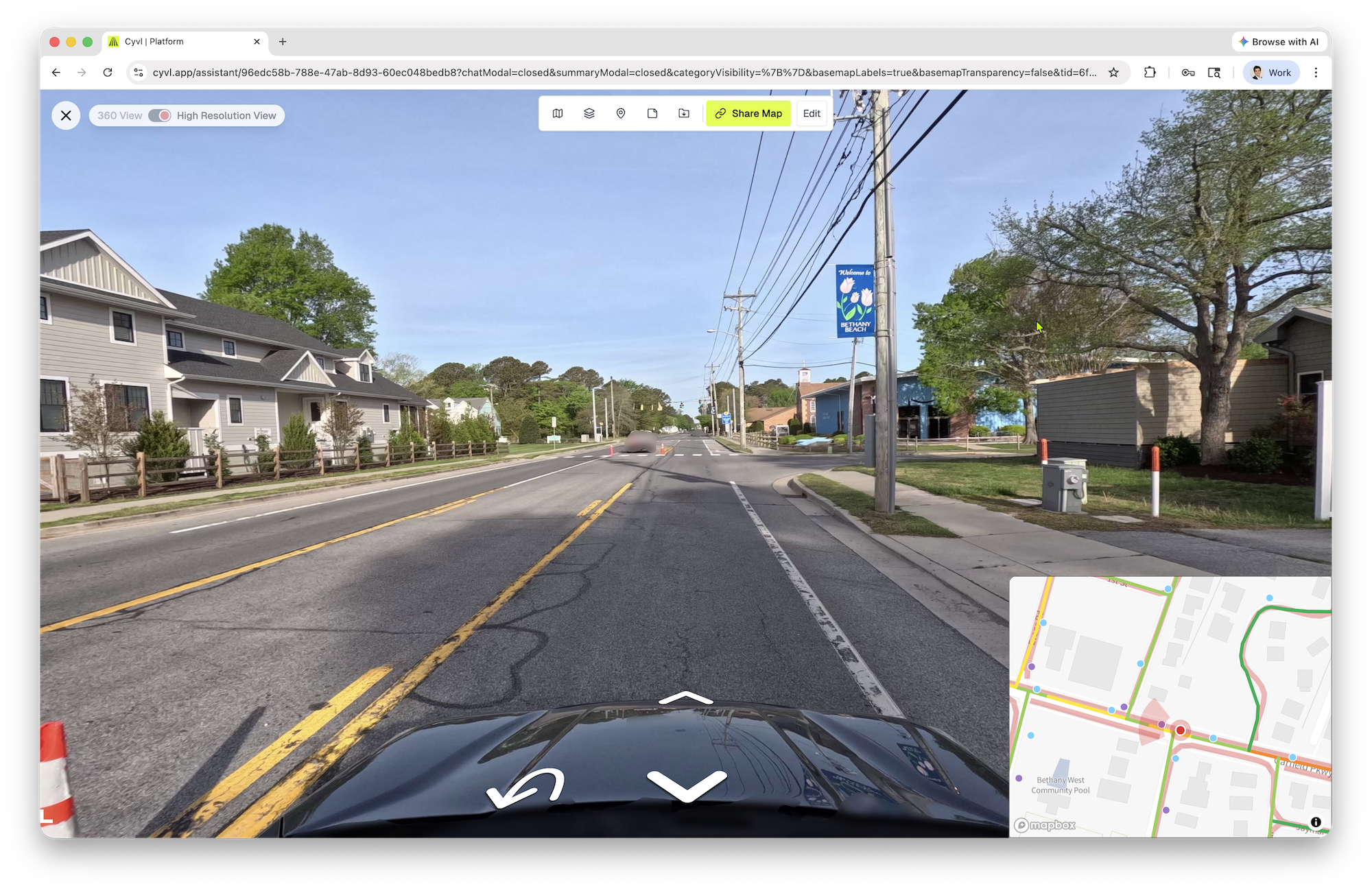
A city can assess road conditions by mounting a sensor rig on an existing fleet vehicle and driving normal routes — no dedicated survey crew required. Cyvl ships a self-install sensor rig that captures LiDAR and 360° imagery; its AI then builds a digital twin of the network and auto-generates condition scores and an asset inventory. Because collection rides along with regular operations, an entire city's road network can be captured in days, not months.
What is an infrastructure (road) digital twin?
An infrastructure digital twin is a centimeter-precise virtual replica of a city's physical assets — roads, sidewalks, signs, signals, and more — kept current with real-world condition data. Cyvl builds the twin from LiDAR and 360° imagery and layers AI-detected conditions on top, so public works teams can inspect, plan budgets, and dispatch work orders from a single web platform instead of driving out to the site.
What is a right-of-way (ROW) asset inventory?
A right-of-way asset inventory is a geolocated catalog of every public asset in the road corridor — signs, signals, streetlights, manholes, catch basins, guardrails, and more — each with a location and condition. Cyvl auto-detects 50+ asset types from a single drive. In Manchester, NH, it cataloged 12,249 streetlights, 9,547 trees, 9,624 manholes, 9,268 catch basins, and 33,255 MUTCD signs.
Can it assess sidewalks and ADA compliance?
Yes. The same LiDAR and imagery that scores pavement also detects sidewalk segments and ADA features like curb ramps, measuring slope and condition to support ADA transition plans. This gives agencies a defensible, network-wide picture of pedestrian-network compliance without manual measurement.
How much does automated pavement assessment cost, and do we need to buy vehicles?
No capital vehicle purchase is required. Cyvl ships a sensor rig that a city self-installs on existing fleet vehicles in minutes, which removes the cost of dedicated survey vehicles and crews. Pricing scales with network size — request a pilot for a network-specific quote.

Proof
How Buffalo turned data into a campaign promise kept.
Mayor Sean Ryan's “Pave It!” initiative made road quality a citywide priority. CYVL gave his team the ground truth to execute it — every street, every condition, every dollar accounted for.
Read the case study